Chemical Etching
Micro-metallic mesh
At present, the etched micro metallic mesh has been widely used in the processing fields of various precision filtering equipment, chemical fiber spinnerets, jet engine nozzles, computer print heads, printed circuit boards, TV mask plates, star hole plates of planetariums, aviation gyroscope instrument components, aircraft turbine blades, medical devices and other parts.
Hysen adopts a unique photochemical etching process to process some precision meshes. These products have extremely high tolerance requirements. The pore walls of the processed micro metallic mesh have no burrs, the pore diameters are uniform, and the roundness is good. With our unique chemical etching process, we also actively deal with the batch processing of micro metallic meshes.
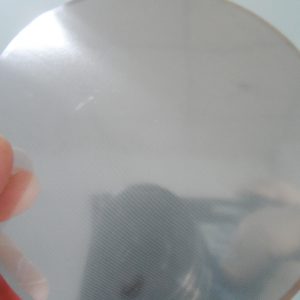
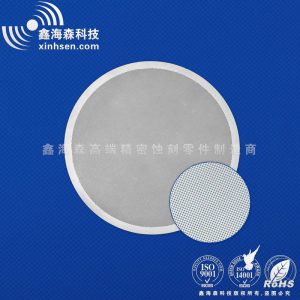
The Key Points for Micro metallic mesh etching
When engaging in the micro – metallic mesh etching process, one of the most critical factors that demands careful consideration is the material thickness. This parameter significantly influences the feasibility and success of the entire etching operation.
Typically, in the production of products featuring a chemical – etched perforated mesh, a fundamental rule prevails. The thickness of the material selected for use must be smaller than the pore diameter intended for processing. This is because when the material thickness is less than the pore diameter, the chemical etching agents can effectively penetrate and etch through the material, creating the desired perforations with relative ease and precision.
Conversely, if the material thickness exceeds the pore diameter, the etching process becomes inapplicable. In such a scenario, the etching agents may not be able to fully penetrate the material to form the required pores. This could lead to incomplete or distorted perforations, rendering the final product unusable for its intended purpose. Thus, understanding and adhering to this relationship between material thickness and pore diameter is essential for a successful micro – metallic mesh etching process.
Benefits for photochemical etching
- High Precision: Photochemical etching can achieve extremely tight tolerances and intricate designs with sharp edges and fine details. This precision is difficult to achieve with traditional machining methods.
- Cost-Effective for Prototyping and Low Volume Production: Unlike traditional machining processes that require expensive tooling and setup costs, photochemical etching doesn’t require the production of physical tooling like molds or dies. This makes it cost-effective for prototyping and small production runs.
- No Mechanical Stress: Since photochemical etching is a chemical process, there is no mechanical force applied to the material being etched. This means that delicate or thin materials can be processed without the risk of distortion, warping, or burrs that can occur in traditional machining processes.
- Versatility in Material Selection: Photochemical etching can be applied to a wide range of metals and alloys, including stainless steel, copper, brass, aluminum, and nickel alloys. It can also process materials with varying thicknesses, from thin foils to thicker plates.
- Complex Geometries: The process can produce complex and intricate shapes that may be difficult or impossible to achieve with traditional machining methods. This includes features such as small holes, slots, and channels, as well as irregular or contoured shapes.
- Minimal Material Waste: Unlike traditional machining methods where material is subtracted from a larger block, photochemical etching is a subtractive process that only removes material where needed. This results in minimal material waste, making it a more environmentally friendly manufacturing option.
- Scalability: Photochemical etching is scalable, meaning it can be used for both small-scale production runs and large-volume manufacturing. The process can easily accommodate changes in production volume without significant adjustments to the manufacturing setup.
- Surface Finish Control: The etching process can be tailored to achieve specific surface finishes, from matte to highly polished, depending on the application requirements.